
Sorting through old photographs the other day reminded me of a visit to Monk’s House, an unassuming brick and weather-boarded cottage at the end of the village of Rodmell, not far from Lewes in Sussex. From 1919 until their deaths, it was the home of Virginia and Leonard Woolf.

Bought for £700 at auction in 1919, the 17th-century cottage was in a primitive state without water, gas or electric. But the Woolfs could see it would be perfect as a place for quiet and concentration away from the stresses of London. There they would write, garden and contemplate. Now in the care of the National Trust, Monk’s House is an easy day trip from London.
Monk’s House is of course a top literary destination (novelist Virginia Woolf wrote many of her major works there). But for the painter, colourist, interior designer, and photographer there is also much to inspire at Monk’s House, with its perfectly framed vistas and tableaux in both house and garden.
Echoes of Bloomsbury
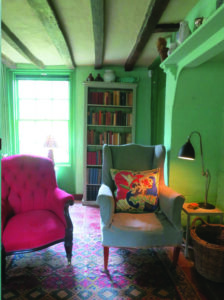
The interior of Monk’s House is painted in vibrant colours untypical of time, including shades of green, blue, yellow, and pomegranate. Virginia Woolf painted many of the walls herself in these distinctive, brightly coloured distemper paints. She was likely inspired by her sister Vanessa Bell’s palette and painterly approach to interior design at nearby Charleston farmhouse in Firle, East Sussex. At Charleston virtually every surface and object is covered in hand painted designs, many by Bloomsbury Group artists.
Vanessa Bell was not only a painter but one of the key figures behind the Omega Workshops. This experimental project sought to bring the shapes and colours of modernism into the home and to break down the division between fine art and crafts or applied arts.
While Charleston gave full expression to the Omega Workshops aesthetic, with its bold, expressive designs, hand painted furniture, textiles, ceramics, and murals, Omega’s influence echoes more softly at Monk’s House. Yet even in this more modest setting, the colours, hand painted furniture, and relaxed, bohemian feel contrasted dramatically with the stuffy interiors of post-Edwardian England.
Shades of Green
The sitting room at Monk’s House is famously painted in Virginia’s favourite shade of green (sometimes referred to today as “Bloomsbury Green” or viridian green). There you see matching a hand-painted table and matching chairs decorated by Vanessa Bell and artist Duncan Grant and monogrammed with Virginia’s initials. A member of the Bloomsbury Group, Grant was also a co-director of the Omega Workshops. He lived with Vanessa Bell for long periods at Charleston in an artistic collaboration that reflected the Bloomsbury Group’s modernist design principles.

Virginia Woolf’s bedroom is light and tranquil. Windows overlook the garden and the walls feature an “underwater feeling shade of green”. The dining room and kitchen are decorated in muted Bloomsbury hues, including eau de nil greens. Throughout the house, other walls are painted in shades of yellow, blue, rose pink, and pomegranate.
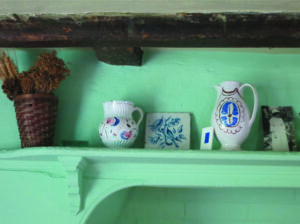
Colourful pieces of hand-decorated pottery, lampshades and tea trays complement the watery greens on the walls. Easel paintings depict domestic scenes of the house, its inhabitants and the gardens beyond—all executed in the vibrant colourist palette associated with the Bloomsbury group painters.
The gardens which surround the property are linked formally with Sussex style laid brick paths. Beyond the wild orchards are views the steeple of nearby St. Peters church. And to the east lie views of Mount Caburn in the Sussex Downs, which Virginia Woolf could contemplate from her writing room in the garden.
Enduring Influence of The Omega Workshops
Artist and writer Roger Fry founded the Omega Workshops in July 1913 in Bloomsbury, London. For Fry, the Omega Workshops represented “Post-Impressionist design in action”. In other words, The Omega Workshops sought to blur the line between fine art and design. In so doing, the project’s goal was to apply the principles and colours of modern art to the domestic interior.
Artists were employed by the Omega Workshops to design and produce hand painted furniture, textiles, screens, murals, ceramics, rugs, household accessories, and more. Expressive qualities were favoured over “shop finishes.” Vanessa Bell was a co-director of the Workshops, and Virginia was a customer, until the Workshops closed in 1919 (the same year the Woolfs purchased Monk’s House).
The Omega Workshops laid the groundwork for the dynamic Art Deco style that succeeded it in the 1920s and 30s. And over 100 years later its influence can still be seen. Hand painted furniture by individual artisans in the Omega style pay direct homage. Textiles and wallpapers like those by Sanderson’s reference Bloomsbury shades and patterns. Paints such as Annie Sloan’s Chalk Paint collaboration with Charleston Trust rekindle Omega’s colours. Perhaps the most lasting celebration of the Omega Workshop style are the eclectic, colourful, and expressive interiors still being designed and enjoyed today.
Nicola Thwaites Specialist Decorating – London – provides specialist paint finishes and decorative painting for hand painted furniture and cabinetry. We work both on site and off site in our studio.