
Out & About is an occasional series highlighting decorative painting and other specialist decorating skills that are not only worth seeing, but worth going to see.
Specialist Decorating at Orleans House Gallery, Twickenham, London
Pick a sunny day and take a dappled walk along Twickenham riverside path to what remains of Orleans House. There you’ll happen on the beautifully restored Grade I listed Octagon Room, a dazzling example of 18th century painted and gilded decorative plasterwork—works that today often fall under the rubric of specialist decorating.
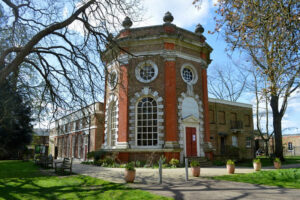
Architect John James built the riverside villa in 1710 for the politician and diplomat James Johnston. However, the residence was later named Orleans House after Louis-Phillipe, the Duke of Orleans, who resided there from 1815-17 during his exile from France.
Decorative Display to Curry Favour with Royalty
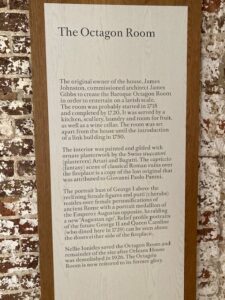
Architect James Gibb added the exuberant octagonal Baroque banquet chamber to Orleans House in 1720. The purpose of the Octagon Room was to get into royalty’s good graces by providing a novel venue to host, variously, King George I, II, and other royal guests. Notable among these was George II’s Queen Consort, Caroline.
Rescuing the Octagon Room
Alas, Orleans House fell derelict and was mostly demolished in 1926. Unbelievably, the site was used as a gravel pit throughout the 1930s. The Octagon Room only survived by the skin of its teeth thanks to swift action by the Honorable Nellie Ionides, who lived next door at Riverside House. When gravel merchants purchased and tore down the main house, she acquired the Octagon Room, in addition to its service wing and stable block. An art collector and dog lover (with a special fondness for Standard Poodles), Nellie bequeathed the remains of Orleans House to the Borough of Twickenham, as it was then. And what a fabulous remnant!
Decorative Art in the Octagon Room
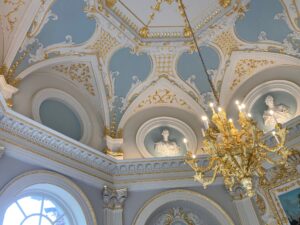
According to the Institute of Historic Building Conservation, the original interior was embellished with painted and gilded ornate plasterwork by the Swiss “stuccatori” Giovanni Battista Bagutti and Giuseppe Arturi. These renowned artisans also worked on other prominent Georgian buildings in England. These included St Martin-the-Fields, Castle Howard and Clandon Park House in Surrey.*
Throughout art history, craftsmen and artisans of the guilds have very rarely earned the same level of recognition as painters and sculptors. How many of us (even specialist decorators) can name our favourite ornamental plasterer? Pleasingly, the decorative artists of the Octagon Room have earned lasting name-recognition.
.
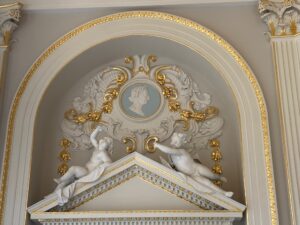
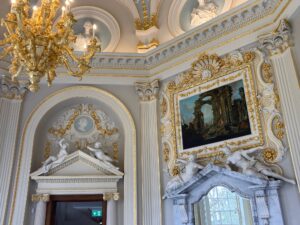
A fantasy scene of classical Roman ruins hangs over the fireplace. A portrait bust of George I is positioned above cherubs and reclining female figures–personifications of ancient Rome. Relief profile portraits of the future George II and Queen Caroline (who dined there in 1729) can be seen above the doors either side of the fireplace.
Repairs and Restoration
From what I have read, repairs and restoration of the Octagon Room were phased over many years, starting in the mid-1990s. The architectural firm Donald Insall Associates oversaw the restoration. They drew on the skills of John Joy Plasterers for plasterwork. Hare & Humphreys undertook specialist decoration, gilding the interior and creating a new gilded timber chandelier to replace one that had been lost. No doubt other trades and crafts were also involved.
Today the Octagon Room, its service wing and outbuildings serve as the Orleans House Gallery under the auspices of Richmond Borough. It is also used as a wedding venue.
The Octagon Room was designed to entertain, and it still does. The interior is breathtaking and the restoration, exemplary. It doesn’t get much better than this in the “I-Spy” of specialist decoration! Well worth a visit.
* Magnificent displays of Arturi’s and Bagutti’s decorative plasterwork were destroyed when Clandon Park was gutted by fire in 2015. The window of opportunity closed for artisans to demonstrate and preserve heritage decoration skills when National Trust made the controversial decision not to reinstate most of the principal rooms at Clandon House to the original 18th century designs.